As cities, agencies, and property owners look for practical ways to reduce heat, extend pavement life, and meet sustainability goals, it’s no longer enough to ask, “Does this product work?”
The bigger question is: What’s the environmental impact over its full lifecycle?
To help answer that, CoolSeal commissioned a third-party Life Cycle Assessment (LCA) conducted by ClimeCo. The goal was simple: clearly understand the environmental footprint of CoolSeal from production through installation using a standardized and transparent methodology.
That LCA served as the basis for CoolSeal’s third-party verified Environmental Product Declaration (EPD), providing standardized, ISO-aligned sustainability documentation used in public procurement, specifications, and green building programs.
What Is a Lifecycle Assessment (and Why It Matters)
A Life Cycle Assessment evaluates the environmental impacts of a product from raw material sourcing through manufacturing, transportation, and installation. Rather than focusing on one attribute, like reflectivity or durability, an LCA shows where impacts truly occur and how significant they are across the full system.
For infrastructure decision-makers, LCAs help:
- Support LEED and sustainability reporting
- Inform procurement and specification decisions
- Compare products on a consistent, apples-to-apples basis
From LCA to EPD: How CoolSeal Earned a Verified EPD
While an LCA is the technical study that calculates lifecycle impacts, an Environmental Product Declaration (EPD) is the formal, publishable document that communicates those results in a standardized format.
In other words: ClimeCo completed the LCA, and SCS Global Services used that data to produce and verify CoolSeal’s official EPD.
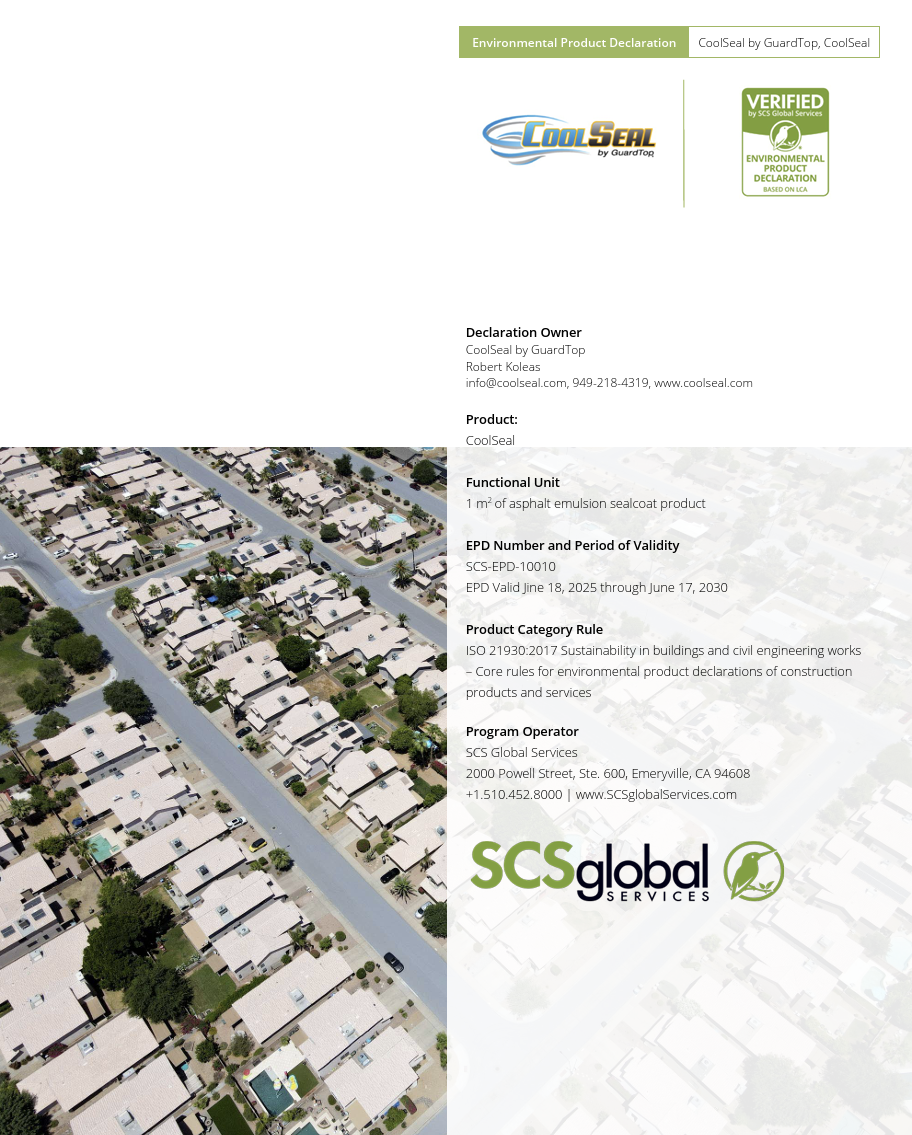
This is a major milestone because EPDs follow strict international standards and require independent review and verification. CoolSeal’s EPD is a Type III Environmental Product Declaration, verified by SCS Global Services, and conforms to ISO requirements including ISO 14025 and ISO 21930.
The EPD includes the official verification label, third-party signatures, and reporting structure needed for transparency in LEED and sustainability-driven procurement.
CoolSeal’s verified EPD is registered as SCS-EPD-10010 and is valid from June 18, 2025 through June 17, 2030
What the CoolSeal LCA and EPD Evaluated
Both the LCA and EPD follow internationally recognized ISO standards and focus on a cradle-to-gate with options boundary (also referred to as A1–A5), which includes:
- A1: Raw material production
- A2: Raw material transportation
- A3: Manufacturing
- A4: Transportation to the job site
- A5: Installation
The study evaluated impacts using a declared functional unit of one square meter (1 m²) of applied CoolSeal, which allows results to be compared consistently across projects and products.
It’s important to note that the study does not include the use phase or end-of-life. This is standard practice for EPD reporting and ensures clarity and consistency in lifecycle reporting.
Environmental Impacts
The LCA measured six impact categories commonly used in LEED and sustainability assessments:
- Global Warming Potential: Greenhouse gas emissions (carbon footprint)
- Ozone Depletion: Impacts on the earth’s ozone layer
- Acidification: Air pollutants that contribute to acid rain
- Eutrophication: Nutrient pollution that affects waterways
- Smog Formation: Pollutants that contribute to ground-level ozone
- Non-Renewable Energy Use: Fossil energy consumption
These impact categories are presented in CoolSeal’s verified EPD using the required lifecycle impact methodology and reporting format.
What the Results Showed
Across all six impact categories, one trend was clear:
The majority of environmental impact comes from raw material production (A1).
Manufacturing, transportation, and installation contributed relatively small portions of the overall footprint. Installation impacts, in particular, were minimal due to efficient spray application and low material loss.
This means the environmental profile of CoolSeal is driven primarily by the materials required to deliver its performance—reflectivity, durability, and longevity—not by how it is applied in the field.
Efficiency Built Into Manufacturing and Installation
Several aspects of CoolSeal’s design help limit impacts beyond raw materials:
- Water-based formulation, avoiding solvent-based systems
- Bulk tanker delivery, eliminating packaging waste
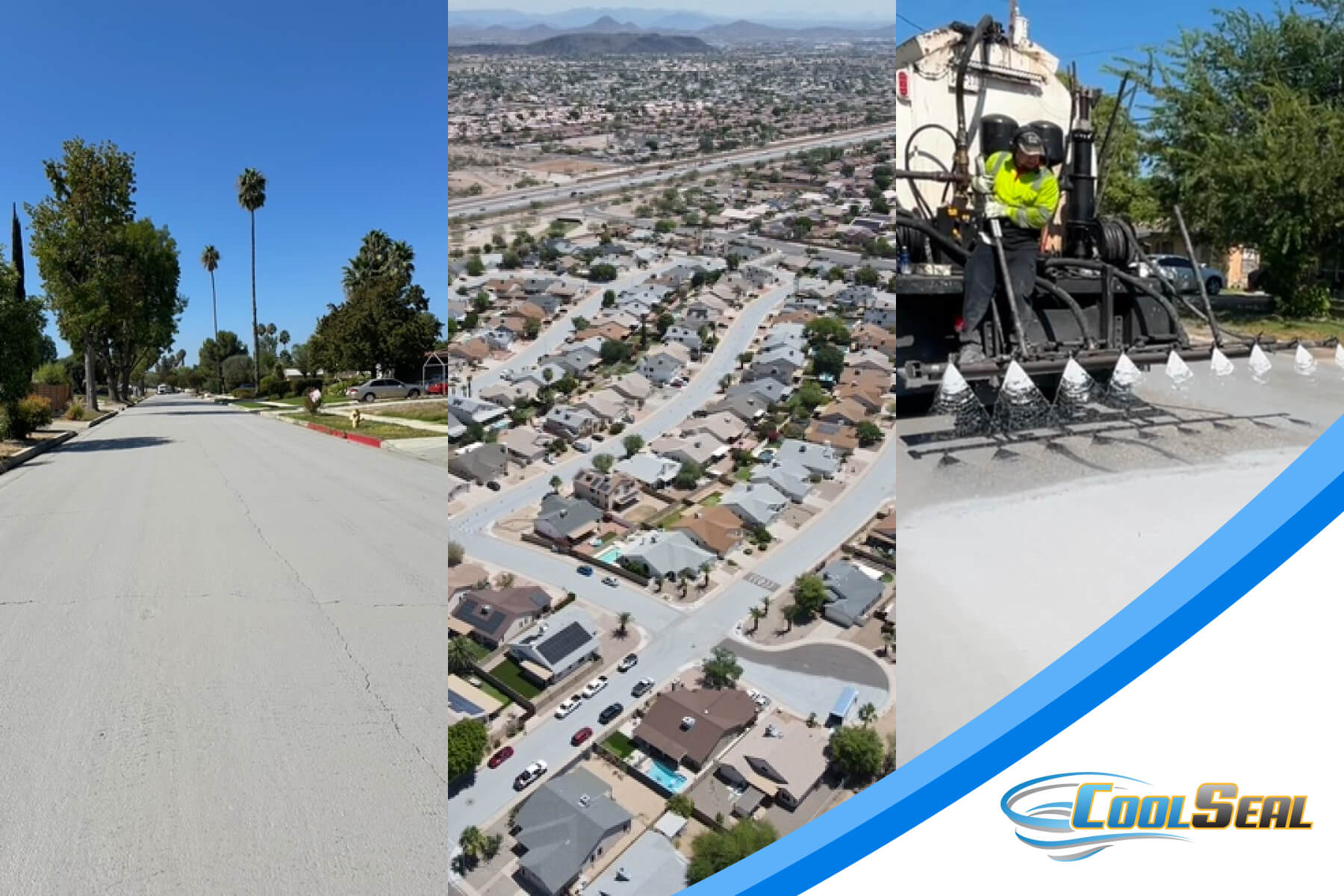
- Computerized spray application, minimizing material loss
- Low fuel use during installation relative to total lifecycle impacts
These efficiencies help keep downstream impacts small and predictable for contractors and agencies alike.
This type of lifecycle transparency is becoming increasingly important as states and municipalities look to make data-backed infrastructure decisions, especially in regions focused on heat mitigation and climate resilience.
In California, for example, state agencies have spent years researching and piloting cool pavement strategies as part of broader efforts to address urban heat islands and long-term infrastructure performance. While there is currently no statewide mandate requiring cool pavement coatings, California has invested heavily in lifecycle analysis tools, pilot programs, and guidance to help public agencies evaluate environmental tradeoffs across pavement materials.
As heat resilience strategies move from pilot programs into standard practice, verified lifecycle documentation is playing a larger role in procurement, specifications, and sustainability reporting. Tools like EPDs help agencies, property owners, and project teams prepare for evolving requirements while making informed decisions today.
Read the Verified EPD and Full LCA Report
CoolSeal’s lifecycle impact results are documented in these two resources:
The verified Environmental Product Declaration (EPD) — independently reviewed and certified by SCS Global Services
The full Life Cycle Assessment (LCA) — the detailed technical study conducted by ClimeCo that supports the EPD
If you’d like to explore the data and verification behind these findings in more detail, you can request access to the full reports below.
Request access to the verified CoolSeal EPD
Request access to the full CoolSeal Life Cycle Assessment (LCA)